

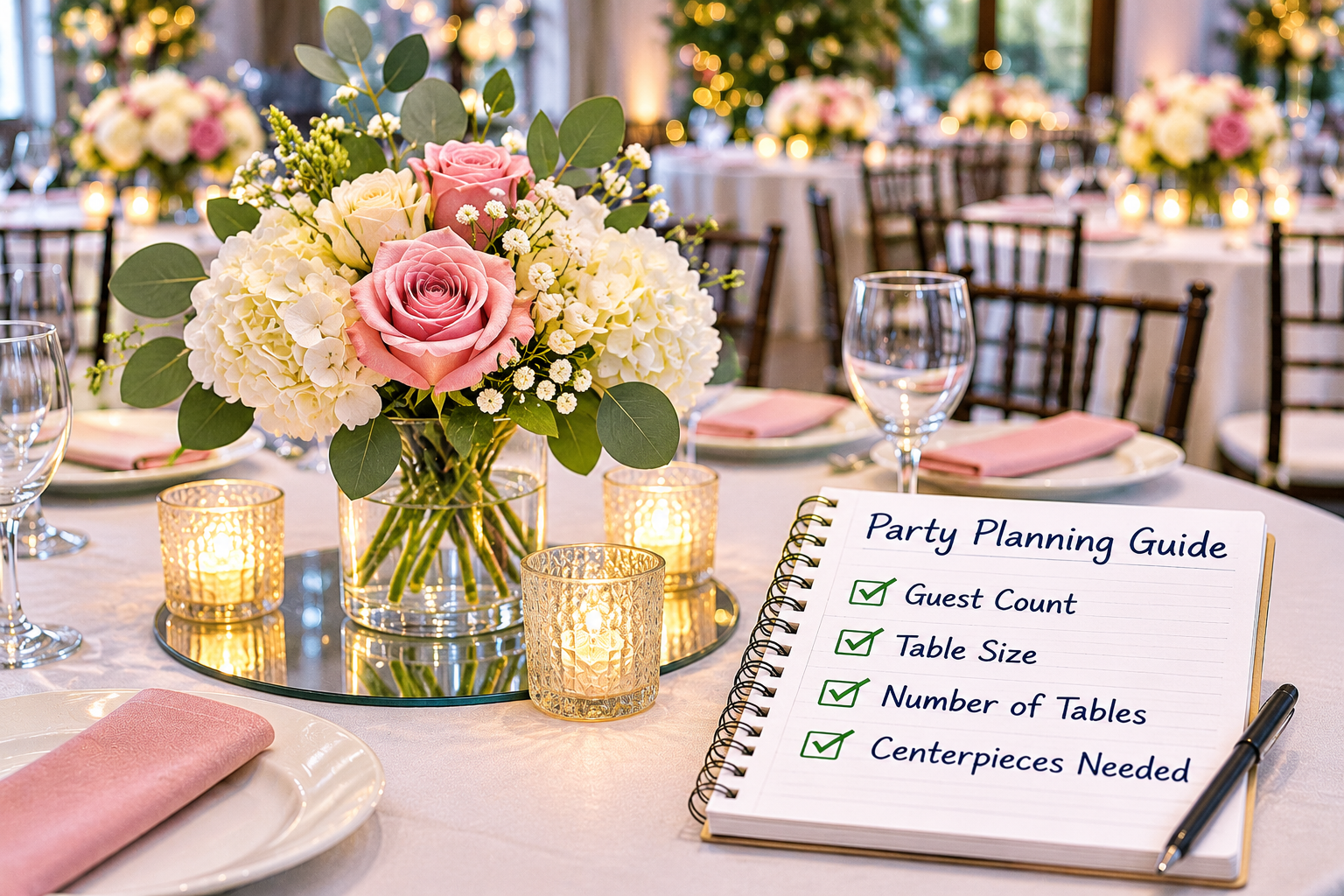
Planning a celebration in San Francisco means thinking through every detail, from the guest list to the table settings. One question that comes up for nearly every event planner, bride, or host is how many centerpieces to order. Get it wrong in either direction and you either overspend or leave tables looking bare.
Quick Answer
Count the number of tables your guests will actually sit at, then add one to three arrangements for focal points like a head table, buffet, bar, or entry display. For most seated events, one centerpiece per guest table is the standard. If you are mixing round and long banquet tables, the shapes and lengths will affect how many arrangements each table needs to look full and balanced.
What San Francisco Event Hosts Should Know
-
Round tables, which are the most common configuration at venues across the city, typically need one centerpiece placed at the center, though the height and spread of that arrangement matters as much as the count.
-
Long banquet tables, popular at receptions in the Bay Area’s converted warehouse and industrial-chic venues, generally need one arrangement for every four to five feet of table length to avoid empty stretches.
-
San Francisco’s fog and cool coastal air are actually favorable for fresh flowers, meaning blooms hold up well through long evening events without wilting under heat.
-
Intimate venues in neighborhoods like Noe Valley or Cole Valley often have tighter table spacing, so centerpiece height becomes a sightline concern for guests seated across from one another.
-
Beyond guest tables, hosts frequently overlook flower placement at the bar, the buffet, the gift table, and the entry, all of which shape the overall impression of a well-dressed event.
Why Centerpiece Count Matters for Bay Area Events
San Francisco venues vary dramatically in size, layout, and atmosphere. A seated dinner at a historic hall in the Civic Center has entirely different spatial dynamics than a reception in a Dogpatch loft or a garden party in the Sunset District. The number of centerpieces you need is directly tied to the number of tables in your specific room layout, not a generic formula pulled from a national wedding blog.
Flower costs are a real consideration, and ordering too many arrangements without a clear table count means spending money on pieces that end up crowded or repositioned. Ordering too few leaves some tables noticeably plain, which guests notice even when they cannot immediately explain why the room feels unfinished. Getting the count right before you meet with your florist saves time, keeps the budget honest, and ensures the design vision actually translates to the room.
House of Flowers, The Delicate Daisy has served San Francisco hosts since 1939, and our team, led by Roxane Rockwell, works through centerpiece planning with clients as part of our occasional flowers and event design process. We source fresh stems from the flower market three times a week, so what we bring to your event reflects what is at peak quality right now, not what was available last week.
Local Data or Field Observations
This section reflects common professional observations from working with event clients in San Francisco and the broader Bay Area, not aggregated survey data. Table count errors are among the most frequent planning oversights we see, and they almost always stem from one of three sources: forgetting non-guest tables that also need florals, miscounting tables because a final floor plan was not confirmed, or underestimating how much visual space a long banquet table actually requires.
Local Impact
For San Francisco hosts, centerpiece planning has a direct effect on how a venue reads to guests arriving from neighborhoods across the city and the Peninsula. Rooms in older Richmond District buildings or classic Sunset District event spaces can feel cavernous without enough floral presence.
Conversely, cozy venues in Pacific Heights or the Inner Sunset can feel cluttered if arrangements are too tall or too numerous. Matching the arrangement count and scale to the room is what separates a thoughtfully designed event from a pretty one that still feels slightly off.
Warning Signs You Underplanned Your Centerpieces
-
You counted total tables at the venue but did not subtract tables used for the DJ, gifts, or catering stations.
-
Your floor plan has changed since you gave your florist a table count.
-
You have one or more long banquet tables but ordered only one centerpiece for the entire length.
-
You forgot to account for the head table, which often needs a more substantial arrangement or a series of smaller ones running its length.
-
The bar and buffet area have no floral presence, making them feel like service stations rather than part of the designed space.
-
You ordered arrangements for every table but left the entry or foyer completely bare, which is the first impression guests receive.
-
Your guest count increased after your initial floral order and no one updated the table count with the florist.
When to Call a Professional
You can safely work out a rough centerpiece count on your own using a confirmed table layout. Count every table where guests will be seated, note the shape of each one, and flag any additional focal points that need flowers. That is a reasonable starting point.
Bring a professional florist into the conversation as soon as you are thinking about height, scale, and how arrangements will interact with lighting, ceiling height, and the room’s existing palette. San Francisco venues range from bright, windowed spaces in the Marina to dim, candlelit rooms in the Castro, and what reads as the right size in one setting can look completely wrong in another. A florist familiar with Bay Area venues can steer you away from common proportion mistakes before any flowers are ordered.
Common Causes of Centerpiece Count Errors
Most planning errors fall into predictable patterns, and most of them are easy to fix with one focused conversation before finalizing an order.
Working from an estimated guest count instead of a confirmed floor plan. A rough guest count does not tell you how many tables will actually be set. Table size, venue capacity, and seating style all affect the final number.
Treating all tables the same. Round tables seat a consistent number of guests and need one central arrangement. Long tables seat more people across a wider surface and need more flowers to feel dressed.
Forgetting the head table. The head table is usually the visual anchor of a reception or formal dinner, yet it is frequently treated as an afterthought in floral planning.
Overlooking accent tables. Bars, buffets, escort card tables, and gift tables are part of the room design. Leaving them bare creates visual gaps that interrupt the overall look.
Locking in a count before the venue confirms the layout. Floor plans change. If your florist is working from an outdated diagram, the count will be off.
Prevention and Maintenance
The single best preventive step is confirming your final floor plan with the venue at least two to three weeks before your event date. Once you have a confirmed diagram showing every table, its shape, and its position in the room, share it directly with your florist.
For events in San Francisco’s busier seasons, particularly spring and early fall when the city’s social calendar is packed, early confirmation also gives your florist time to source the specific stems you want before availability tightens at the market.
For fresh flower centerpieces, timing matters. Arrangements ordered for a Saturday event are typically prepared and conditioned in the days leading up to delivery, so last-minute count changes can disrupt availability and preparation schedules.
Expected Results
With a confirmed table count, a clear room layout, and open communication about height preferences and budget, most hosts find that centerpiece planning is straightforward. You can expect arrangements scaled to your tables, coordinated across the room, and delivered ready to place.
Fresh flowers sourced earlier in the week will be fully open and at their best by the time guests arrive, particularly given San Francisco’s cool, damp climate, which is gentler on cut flowers than warmer inland conditions.
Common Mistakes
Mistake: Ordering Based on Total Guest Count Rather Than Table Count
Consequence: You end up with the wrong number of arrangements, either too many for the actual tables set or too few.
Better approach: Base your order on the number of physical tables in your confirmed floor plan.
Mistake: Choosing a Tall Centerpiece for a Low-Ceilinged Venue in an Older San Francisco Building
Consequence: Guests seated across from each other cannot make eye contact, and conversation across the table is blocked.
Better approach: Confirm the ceiling height and ask your florist to suggest a height that keeps sightlines open.
Mistake: Finalizing the Floral Order Before the Venue Confirms Whether Rounds or Long Tables Will Be Used
Consequence: You order one arrangement per table and then learn the layout switched to banquet-style seating that needs three.
Better approach: Get written confirmation of table style from the venue before meeting with your florist.
Mistake: Skipping Floral Accents at the Bar Because It Feels Like an Unnecessary Cost
Consequence: The bar becomes the most visited spot in the room and the least decorated, which guests notice.
Better approach: Budget for one smaller accent arrangement at the bar and one at the buffet or food station.
Common Local Scenario
This is a typical scenario based on the kind of planning conversations we have regularly with San Francisco clients, not a specific past project. A couple planning a 90-person dinner reception at a venue near Golden Gate Park initially requests centerpieces for ten tables based on an early estimate.
When the final floor plan arrives, it shows nine round guest tables, one long head table running six feet, one bar cart near the entry, and a gift table near the door. The couple’s original count covered only the round tables.
Working through the layout together, we plan nine arrangements for the round tables, three lower arrangements running the head table, one accent piece for the bar, and one smaller arrangement for the gift table. The total shifts from ten pieces to fourteen, reflecting the actual room rather than the original estimate. The budget adjusts slightly, but the room reads as designed from the moment guests walk in.
Related Service Solutions
Our occasional flowers service covers exactly this kind of event-specific floral planning. Whether you are hosting an intimate dinner in the Richmond District or a larger celebration at a venue elsewhere in San Francisco, we can help you work through table count, arrangement scale, height considerations, and accent placement.
Roxane and our team source fresh flowers from the market three times a week, which means your centerpieces reflect genuine seasonal availability rather than a standing generic inventory. We also work with hosts who need a mix of centerpiece styles across the same event, low and lush for round tables alongside something more linear for a long head table, keeping everything cohesive without making every table look identical.
[Request Your Centerpiece Consultation]
Comparing Your Options
| Approach | Best For | Trade-Off |
|---|---|---|
| One centerpiece per round table | Most seated dinners and receptions | Does not scale to banquet or head tables |
| Graduated heights across tables | Rooms where visual variety is a design goal | Requires more planning to keep the look cohesive |
| Clusters of smaller arrangements | Long tables, rustic or garden-style events | Needs more individual pieces, affects per-table cost |
| Single large statement piece | Smaller rooms or intimate dinners | Can feel sparse if the room is large |
| Accent-only approach at secondary tables | Tight budgets, minimal style | Secondary tables may still look underdressed |
Service Areas
We are located in San Francisco’s Richmond District and serve clients across the city, from Pacific Heights and Noe Valley to the Sunset District and beyond. We also work with hosts planning events in nearby communities across the Bay Area.
Cost of Ignoring the Issue
Undercounting centerpieces is one of the more visible planning gaps at any event. Tables without arrangements read as incomplete to guests, and once an event is underway, there is no practical way to fill that gap.
Last-minute orders placed too close to an event date may not be possible to fulfill with the same stems, colors, or quality as the original order, especially during high-demand periods in the spring and fall when San Francisco’s event calendar is at its busiest. Confirming your count early, based on a real floor plan rather than an estimate, is the most straightforward way to avoid a situation that cannot be corrected on the day.
[Confirm Your Floral Order Before Your Date Fills]
FAQ
How many centerpieces do I need for a 100-person event in San Francisco?
For a 100-person event, count the actual tables in your confirmed floor plan rather than dividing by a fixed number. Most round tables in San Francisco venues seat eight to ten guests, which puts you at roughly ten to twelve guest tables, plus any additional focal tables such as the head table, bar, or buffet. Each of those focal points typically needs at least one arrangement.
What is the right centerpiece height for a round table?
Centerpiece height on a round table should stay either below 14 inches or rise above 24 inches so guests can see and speak to one another across the table without obstruction. Mid-height arrangements in that 14-to-24-inch range create a visual block that interrupts conversation, which matters especially in the smaller dining rooms common at San Francisco neighborhood venues.
How many arrangements do I need for a long banquet table?
For a long banquet table, plan on one arrangement for roughly every four to five feet of table length. A six-foot head table might need two to three pieces spaced evenly. A ten-foot banquet table would typically need two to three arrangements as well, depending on how full and lush each piece is.
Does the San Francisco fog affect fresh flower centerpieces?
San Francisco’s cool and humid climate is actually favorable for cut flowers. Blooms tend to hold their shape and color well through long evening events, particularly compared to warmer inland venues in the Bay Area. This is one reason fresh flower centerpieces remain a reliable choice for city events across all seasons.
Do I need centerpieces at my bar and buffet in addition to guest tables?
Yes, accent arrangements at the bar and buffet are worth including if your budget allows. These are the highest-traffic spots at most receptions, and bare service tables create a noticeable contrast against dressed guest tables. A single smaller arrangement at each location is typically sufficient.
How far in advance should I confirm my centerpiece count with a San Francisco florist?
Confirm your final count at least two to three weeks before your event date. For events during peak seasons in spring and early fall, earlier is better. This gives your florist time to source specific stems from the market and prepare arrangements on the right timeline for your event day.
Can I mix low and tall centerpieces at the same event?
Yes, mixing heights is a common and effective design choice. Many hosts use taller arrangements at a few featured tables and lower, fuller pieces at standard guest tables. The key is maintaining a consistent color palette and style so the room reads as cohesive rather than uncoordinated.
What is the difference in centerpiece needs between round and long tables?
Round tables need one centrally placed arrangement. Long tables need multiple arrangements spaced along the length to avoid bare stretches. The difference in cost and quantity between a room set with all rounds versus one with long banquet tables can be significant, so confirming table style with your venue early is important.
Should the head table have a different centerpiece than guest tables?
The head table is typically the visual focal point of a reception and benefits from a more substantial floral treatment than standard guest tables. This could mean a larger single arrangement, a series of smaller pieces running the length of the table, or a combination of floral and greenery that creates a cohesive backdrop. The right choice depends on the table length and the overall design direction.
Where is House of Flowers located in San Francisco?
We are located in the Richmond District of San Francisco, where our retail shop is open to the public. Roxane selects fresh flowers from the flower market three times a week, so our available inventory reflects what is genuinely in season and at peak quality when you visit or place an order.
Ready to Plan Your San Francisco Event Centerpieces
Planning the floral side of an event takes more than a quick calculation, but getting the centerpiece count right from the start is one of the most practical things you can do to make a room look finished and feel welcoming. If you are working through a table layout and not sure where to begin, our team in the Richmond District has been helping San Francisco hosts work through exactly these decisions for decades.
Bring us your floor plan, your guest count, and your vision, and we will help you build a floral plan that fits the room and the occasion.
[Schedule Your Floral Consultation]